Small-cap promotion trap checklist is the phrase I wish more retail investors searched before they chased the latest “hidden gem” in a Telegram room. In 2026, the scam is not always a pink-sheet boiler room anymore. Sometimes it looks like a slick Substack thread, a Discord callout, or a social feed full of screenshots that never shows the exit.
The core problem is simple: a good story can move a thinly traded stock a lot faster than a good business can. If you do not have a process for separating real catalysts from engineered hype, you are trading someone else’s liquidity event.
This checklist is the process I would use before buying any tiny float, low-volume, headline-driven stock. It will not make you immune to bad trades, but it will dramatically cut the odds that you end up holding the bag after a promo campaign fades.
1. Start with the float, not the story
Promotion traps thrive in stocks that do not need much money to move. A company with a tiny float, light daily volume, and a hyper-reactive retail audience can spike 20% to 80% on surprisingly little buying pressure.
That is why your first question should be structural: how easy is this stock to push around?
- Is the market cap below roughly $500 million?
- Is average daily dollar volume thin enough that a few aggressive buyers can move it?
- Does the chart show repeated vertical moves followed by violent reversals?
- Has the stock already had multiple 30% to 100% spikes in the past year?
FINRA warns that pump-and-dump operators often target low-priced, low-volume names because they are easier to manipulate. That part has not changed. What has changed is distribution. The pitch now spreads through social feeds and encrypted chat groups faster than old newsletter scams ever could.
If a stock is structurally easy to squeeze, your burden of proof should go up, not down.
2. Look for revenue before you look at narratives
A lot of promotion campaigns sound sophisticated. They borrow real themes, AI infrastructure, tokenization, defense tech, critical minerals, GLP-1 adjacency, then wrap a weak business in a strong macro trend.
The easiest defense is boring: open the filings and find the revenue line, gross margin trend, operating cash flow, and share count. If those numbers do not support the excitement, the story is probably carrying more weight than the business.
That is why I keep coming back to filing-based work. I wrote recently about using SEC EDGAR 8-K filings to spot real developments before the crowd gets there. Real businesses leave a paper trail. Promotions leave screenshots.
Here are the red flags that matter most:
- Tiny revenue base relative to market cap
- Big “pipeline” language with little commercial traction
- Cash burn that requires frequent capital raises
- Adjusted metrics that look great while GAAP losses keep widening
- A giant 2026 target with no credible bridge from current results
If management is selling a $500 million dream off a $10 million business, you should assume dilution is part of the script until proven otherwise.
3. Check dilution like your returns depend on it, because they do
In small-cap land, dilution is usually the real bear case. A promotional stock can look cheap on yesterday’s share count and expensive on tomorrow’s.
Before buying, compare current shares outstanding with the count from one year ago. Then look for:
- At-the-market programs
- Convertible debt
- Warrants with low exercise prices
- S-3 shelf registrations
- Compensation packages heavy on stock issuance
I covered this issue directly in my Datavault AI breakdown. The headline looked exciting. The dilution history mattered more. That is exactly the kind of mismatch a promotion trap feeds on, a big narrative up front, ugly capital structure in the footnotes.
A clean story with a dirty share-count history is usually not actually clean.
4. Ask who benefits if the stock goes up this week
This is my favorite filter because it gets to motive fast.
If the stock jumps 40% this week, who gets paid?
- Existing insiders with a history of selling into strength?
- Promoters who were paid in cash or stock?
- Convertible note holders?
- Early investors sitting on cheap paper?
- The company itself, through easier financing terms?
The answer does not automatically make the company a fraud. But it does tell you whether the excitement is aligned with long-term owners or with short-term exits.
SEC and FINRA guidance keeps circling the same point: bad actors create urgency because urgency shuts off skepticism. When everyone in the room sounds like they already made money, the missing detail is usually that they need you to make their exit possible.
5. Treat social proof as a warning sign, not confirmation
The modern promotion trap is social. You see the same ticker repeated by different accounts, the same catalysts framed in slightly different language, and the same claim that “institutions are loading quietly.” That repetition feels like validation. Sometimes it is just coordination.
Investor.gov warned in February 2026 that scams involving stock recommendations are increasingly being conducted through social media and group chats. The SEC also noted recent trading suspensions tied to small-cap stocks that appeared to be promoted through social channels. FINRA, meanwhile, said complaints tied to fraudulent investment groups and ramp-and-dump style fraud surged, with the FBI citing a 300% increase in related victim complaints in 2025 versus 2024.
That does not mean every hot stock on social media is fake. It means social consensus is not evidence. It is one more variable to investigate.
My rule is simple: if I see five bullish posts, I want one filing, one earnings transcript, and one credible bear case before I even think about sizing a position.
6. Separate catalyst from content marketing
A real catalyst changes the economics of the business. A fake catalyst changes attention.
Real catalysts include things like:
- A signed contract with disclosed economics
- Guidance that implies a real step-up in revenue or margin
- A balance-sheet improvement that lowers financing risk
- Regulatory approval with clear commercialization value
- A credible customer or partner announcement that can be verified
Fake or weak catalysts usually look like this:
- Memorandums of understanding without dollars attached
- “AI strategy” press releases with no product numbers
- Paid media appearances that read like investor marketing
- Vague references to unnamed enterprise customers
- Decks full of total addressable market slides and no execution proof
One of the easiest mistakes in speculative investing is confusing content velocity with business momentum. Those are not the same thing.
7. Use insider behavior as a lie detector
Insider buying is not perfect, but it is usually more informative than promotional chatter. I wrote about this in CEO insider buying surge because actual open-market buying tells you somebody close to the business is taking price risk with real money.
The opposite matters too. If management is leaning hard into a bullish narrative while insiders are absent, or worse, quietly selling, you should slow down.
Questions worth asking:
- Have insiders bought common stock with cash recently?
- Are filings showing sales into strength?
- Are executives being paid mainly in stock while the share count balloons?
- Does management own enough stock that dilution hurts them too?
A stock can still work without insider buying. But a heavily promoted stock with no meaningful insider alignment deserves extra skepticism.
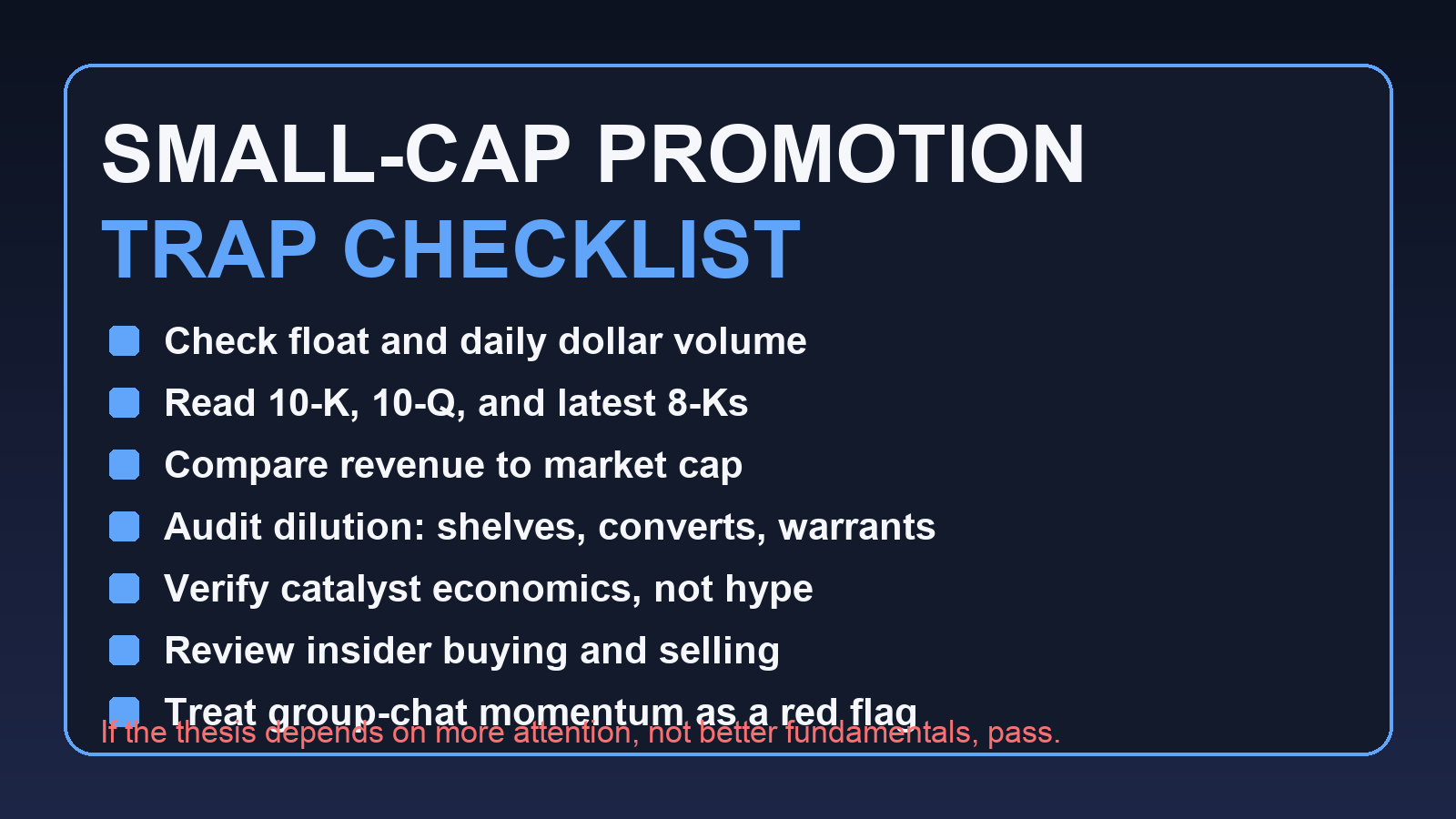
8. Build a pre-trade checklist and obey it
Most investors get trapped because they decide emotionally and research defensively. The fix is a checklist you finish before you buy.
Here is mine:
- Read the latest 10-K, 10-Q, and recent 8-Ks.
- Confirm revenue scale, gross margin, and operating cash flow.
- Check one-year share-count change.
- Look for shelves, converts, warrants, and recent offerings.
- Review average daily dollar volume and float.
- Verify whether the catalyst has disclosed economics.
- Check insider buying and selling.
- Find at least one serious bear case.
- Decide entry, sizing, and exit before entering.
- If the thesis depends on “everyone finding out,” pass.
That last one matters. If your upside case is mostly more attention, you are not investing in fundamentals. You are speculating on promotion dynamics.
The bottom line
The best defense against a small-cap promotion trap is not cynicism. It is process. Thin floats, viral narratives, and vague press releases are a dangerous mix, especially when retail traders confuse momentum with proof.
There are real opportunities in small caps. I spend a lot of time looking for them. But the names worth owning usually survive boring questions. They can show you the revenue, the margins, the capital structure, and the catalyst without asking you to suspend disbelief.
If a stock needs constant promotion to stay interesting, it probably is not a durable investment idea. It is just somebody else’s trade.
This article is for informational purposes only and does not constitute financial advice. Always do your own research and consider consulting with a financial advisor before making investment decisions.