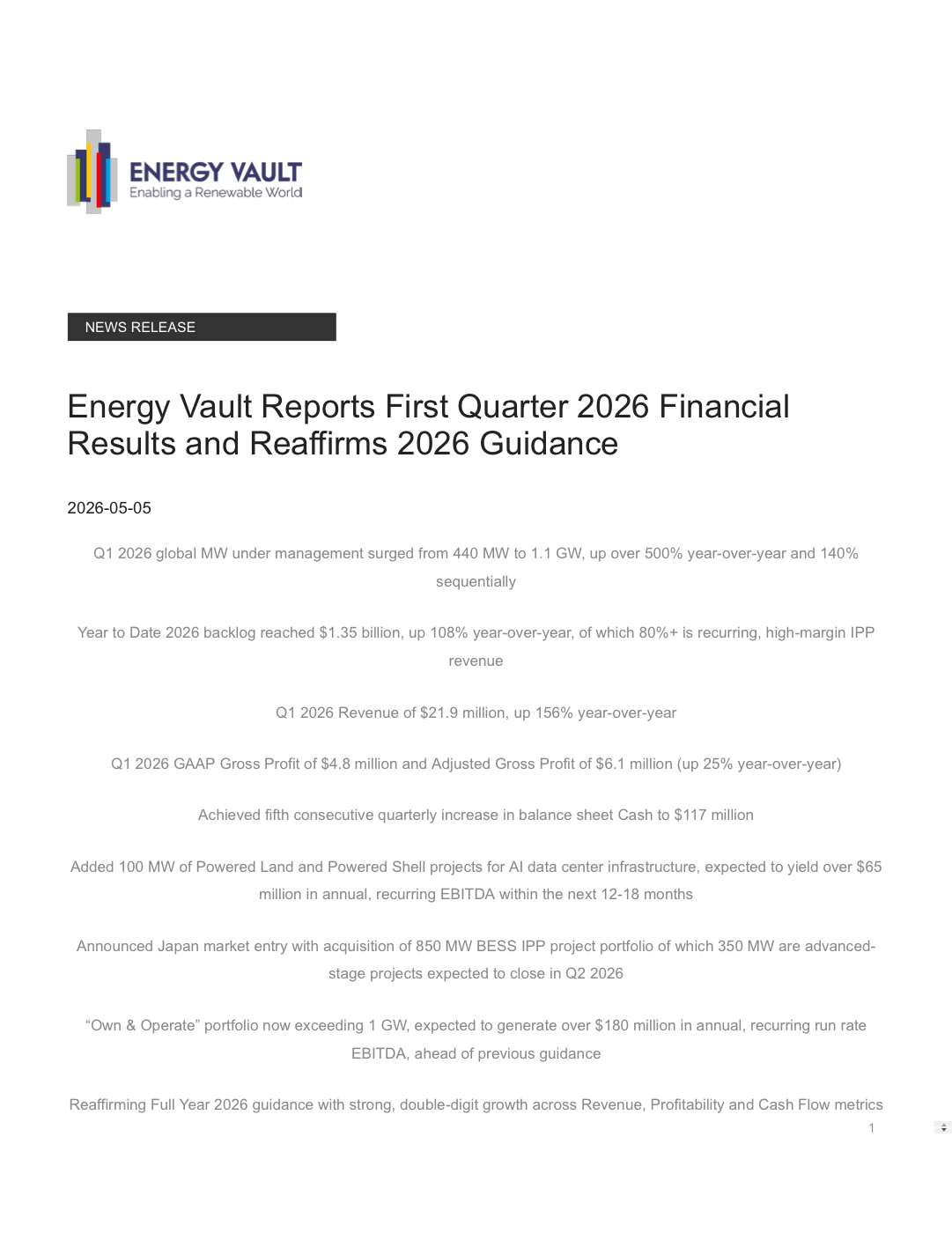
NRGV stock analysis got more interesting after May 5, 2026, but it did not get cleaner. Energy Vault grew first-quarter revenue 156% year over year to $21.9 million, pushed backlog to $1.35 billion, and said megawatts under management jumped to 1.1 GW. Then, less than two weeks later, it added a new up to $75 million senior secured convertible debenture facility. That is the whole story in one paragraph: real operating momentum, real backlog, and real financing risk.
My take is straightforward. Energy Vault still has a credible shot at becoming an AI-power and storage infrastructure winner, but at roughly $5.47 in our June 8, 2026 paper-portfolio snapshot, the easy upside is gone. With about 174.1 million shares outstanding as of March 31, 2026, the stock now carries an implied market cap near $950 million. There is no meaningful P/E to lean on because the company is still loss-making. If you buy NRGV here, you are buying backlog conversion, project execution, and capital-markets trust.
What changed since the last NRGV stock analysis
The April version of this thesis was mostly about headline growth. That part still works. The new wrinkle is that the balance sheet and funding structure matter more than the revenue graph.
In its May 5, 2026 Q1 release, Energy Vault reported:
- $21.9 million of revenue, up from $8.5 million a year earlier.
- $4.8 million of GAAP gross profit and $6.1 million of adjusted gross profit.
- $117 million of cash and cash equivalents.
- $1.35 billion of backlog, up 108% year over year.
- Full-year 2026 revenue guidance of $225 million to $300 million.
Those are good numbers for a company that was still proving it could turn energy-storage hype into real contracts six months ago. Management also said the own-and-operate portfolio now exceeds 1 GW and is expected to generate more than $180 million of annual recurring EBITDA run rate once those assets are online. That is the bull case in one sentence: the business is trying to move from lumpy EPC-style project revenue to a recurring infrastructure model.
The problem is the income statement still looks ugly. The same Q1 release showed a GAAP net loss of $32.5 million and an adjusted net loss of $20.0 million. You do not get to call a company safe just because backlog is large and the slide deck looks ambitious.
Why bulls still have a real argument
There are three reasons I am not dismissing NRGV as just another small-cap energy promo story.
First, the backlog is large enough to matter. At $1.35 billion, backlog is roughly 6 times the low end of 2026 revenue guidance. Management says more than 80% of it is recurring, high-margin IPP revenue. If even a decent chunk of that converts on schedule, the stock can still grow into today’s valuation.
Second, the company keeps adding projects that fit the same thesis. The Q1 release highlighted 100 MW of Powered Land and Powered Shell projects for AI data-center infrastructure that management says could yield more than $65 million in annual recurring EBITDA within the next 12 to 18 months. That is not small. It says management is trying to sell power-ready infrastructure into the same bottleneck everyone in AI keeps talking about: there is not enough electricity where the compute demand is going.
Third, Energy Vault is expanding geographically instead of staying stuck in one speculative pilot market. On May 5, the company also said it expects to close an acquisition for an 850 MW Japanese battery-storage portfolio in Q2 2026, including 350 MW of advanced-stage projects. If that closes cleanly, it gives the business one more market where it can scale the own-and-operate strategy.
This is the piece many small-cap investors miss. NRGV is no longer just “battery storage.” Management is trying to become a capital-heavy infrastructure owner with a software and services layer on top. If that transition works, the stock deserves a better multiple than a commodity project developer. If it does not, the equity gets diluted while investors wait.
The financing risk is no longer a side note
This is where I get less cheerful.
On the positive side, Energy Vault raised $150 million of 5.250% senior convertible notes in February 2026 and used part of the proceeds to repay $45 million of higher-cost debt. On paper, that looks like smart balance-sheet management.
Then came the catch. In the May 18, 2026 10-Q, the company disclosed a new up to $75 million senior secured convertible debenture arrangement with YA II PN, Ltd. That is not the sort of financing you mention once and forget. It is exactly the kind of structure that can pressure a stock if operations wobble.
The same filing spells out why. The debentures come with conversion mechanics tied to share-count caps and stock-price conditions. The 10-Q also adds a new risk factor around the company’s attempt to serve data-center and hyperscaler customers through co-located power assets. Translation: the opportunity is real, but it comes with execution challenges the company has not yet proven it can navigate at scale.
There is another balance-sheet detail worth watching. Total stockholders’ equity fell to roughly $30.5 million at March 31, 2026, down from $67.5 million at year-end 2025. That does not mean the company is about to implode. It does mean this story is being funded through a mix of project ambition, external capital, and a lot of investor patience.
That is why a standard P/E lens is useless here. NRGV does not have one because it does not have earnings. This is a capital-cycle story, not a classic value stock.
The bear case is still the bear case
If you are skeptical, the short version is simple: backlog is not cash, and infrastructure stories can look amazing right up to the moment financing gets expensive.
The main risks look like this:
- Revenue is still lumpy. Q1 revenue of $21.9 million looks tiny compared with the full-year guidance range. That means quarterly numbers can still swing hard based on project timing.
- Gross margin is not clean yet. Q1 GAAP gross margin was 21.9%, well below the 57.1% posted in the prior-year quarter. Management says mix explains it. Fair enough. It still shows how noisy this business can be.
- Dilution is not theoretical. Between the February convertible notes and the May secured debentures, the company is clearly willing to finance growth with instruments that can lean on common shareholders later.
- The AI-power angle is early. The market loves any sentence with “AI infrastructure” in it. That does not mean every powered-land project becomes a high-return asset.
- Commodity and execution risk remain real. The 10-Q explicitly calls out exposure to lithium, steel, aluminum, and cement pricing, plus the operational difficulty of serving large power-delivery customers reliably.
This is why I would rather own NRGV after a pullback than after a hot streak. Great narratives and fragile funding structures are a dangerous combination when a small-cap stock gets crowded.
How I would frame the trade now
Our paper portfolio entered NRGV on March 19, 2026 at $3.59. The current portfolio mark is $5.47, which puts the position up a little more than 52%. The portfolio target remains $6.00 with a $2.75 stop.
That context matters. At $3.59, you were paying for an underfollowed energy-storage name with a fresh backlog story and an AI-power option attached. At $5.47, you are paying much closer to fair value for a company that still needs to prove it can turn backlog into durable cash generation without leaning too hard on converts and structured capital.
If you want a cleaner industrial-technology execution story, EVLV stock analysis is easier to underwrite. If you want a more speculative power-infrastructure setup, HYLN stock analysis is even earlier and riskier. NRGV sits between those two. It has more real backlog than the hype names, but it still has financing risk that quality compounders do not.
I would also keep an eye on how the company talks about year-end cash. Management is targeting $150 million to $200 million of cash at the end of 2026. If they hit that while keeping guidance intact and moving projects toward operation, the stock probably deserves the benefit of the doubt. If they miss revenue timing and come back to the market for more creative financing, the equity story changes fast.
Verdict: compelling business angle, worse stock than it was in April
NRGV stock analysis in June 2026 comes down to discipline. The business angle is still strong. Power for AI infrastructure is a real bottleneck. Grid-scale storage is a real market. A $1.35 billion backlog is not fake. None of that means you should ignore a $32.5 million quarterly GAAP loss and a fresh up to $75 million secured convertible debenture deal.
So here is the clean verdict. Hold if you bought lower. Nibble only on weakness under $5. Avoid chasing it above $6 until management proves backlog conversion and cash generation are both getting better, not just the slide deck.
That is the whole point. Energy Vault may be building something real. The stock just is not the bargain it was a month ago.
Related reads
- HYLN Stock Analysis: Real Catalyst, Real Execution Risk
- EVLV Stock Analysis: Q1 Growth, Higher Bar
- AMPL Stock Analysis: Q1 Growth, AI Still Cheap?
This article is for informational purposes only and does not constitute financial advice. Always do your own research and consider consulting with a financial advisor before making investment decisions.