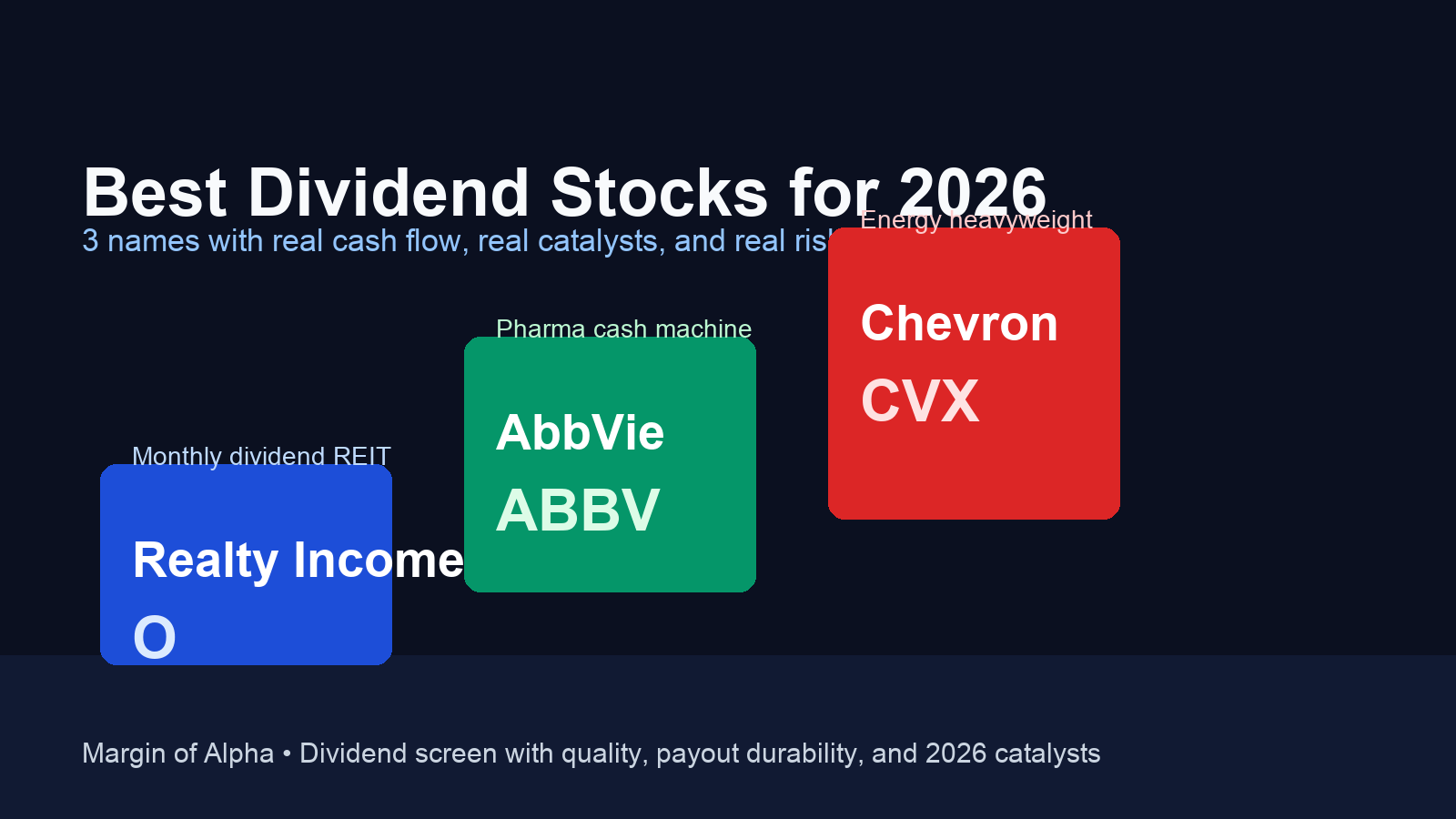
If you want the short version, the best dividend stocks for 2026 are Realty Income (O), AbbVie (ABBV), and Chevron (CVX). They are not the highest-yield names on the screen, but that is the point. I would rather own a 3% to 6% yielder with real revenue, real balance-sheet support, and a visible 2026 catalyst than chase a shaky 12% payout that gets cut the moment the cycle turns.
The setup for dividend investors looks better than it did a year ago. Cash still pays something, but more investors are starting to move back into income stocks as rate-cut expectations creep closer and valuations outside mega-cap tech look less absurd. If you are building an income sleeve, this piece fits next to our dividend ETF guide, not instead of it. Single-stock dividend investing can work, but you need to know exactly what can break.
What I looked for in the best dividend stocks for 2026
I kept the screen simple. First, I wanted companies with real scale and current revenue, not yield traps living off financial engineering. Second, I wanted a clear 2026 reason to care, because dead-money dividend stocks are still dead money. Third, I wanted names where the bear case is obvious enough to write down in plain English.
That last part matters. A lot of dividend coverage reads like marketing copy for retirees. That is useless. The point is not to find stocks that merely pay you. The point is to find stocks that can keep paying you while the business stays intact.
1. Realty Income (O): the cleanest monthly dividend story
Realty Income is still the easiest dividend stock to explain to a normal person. It owns a giant net-lease portfolio, collects rent, and sends out a monthly dividend. As of May 8, 2026, Stock Analysis listed Realty Income at a roughly $57.9 billion market cap with a trailing P/E of 50.7 and about $5.93 billion in trailing-12-month revenue. That P/E looks silly if you judge REITs like industrial companies, which you should not. For this business, funds from operations matter more.
The latest quarter was solid. According to Realty Income’s first-quarter 2026 release, revenue rose to $1.55 billion from $1.38 billion a year earlier. AFFO per share rose 6.6% to $1.13, the company invested $2.8 billion during the quarter, and management raised full-year 2026 AFFO guidance to $4.41 to $4.44 per share. That is exactly what you want from a dividend REIT, modest growth, lots of liquidity, and management acting like the acquisition machine is still working.
The bull case is straightforward. If rates drift lower or even just stop rising, high-quality REITs get room to breathe. Realty Income also has a funding advantage smaller competitors do not. The company had $3.9 billion in available liquidity at quarter-end, and its new private-capital partnerships with Apollo and GIC give it another lane for growth.
The bear case is also straightforward. This is not cheap on a conventional earnings basis, and REITs never stop caring about capital costs. If long rates stay sticky, valuation expansion probably stalls. You are also buying a giant, mature platform, so you should not expect explosive upside. My take: Realty Income is compelling for income-first investors below the mid-$60s. It is a sleep-well position, not a moonshot.
2. AbbVie (ABBV): still a cash machine after the Humira cliff
AbbVie is the best example of why headline fear can create good dividend entries. Everyone knew Humira would roll over. The real question was whether Skyrizi and Rinvoq were big enough to replace it fast enough. So far, the answer looks like yes.
As of May 8, 2026, Stock Analysis pegged AbbVie at a roughly $356.1 billion market cap with a forward P/E of 13.5 and trailing-12-month revenue of $62.82 billion. In first-quarter 2026 results, AbbVie posted net revenue of $15.002 billion, up 12.4% year over year. Skyrizi revenue hit $4.483 billion, up 30.9%, and Rinvoq revenue hit $2.119 billion, up 23.3%. Management also raised full-year adjusted EPS guidance to $14.08 to $14.28.
That is what a durable dividend setup looks like. The old blockbuster is fading, but the replacement engines are already large and still growing. You are not waiting on a science project here. You are getting a scaled pharma business with multiple cash-generating franchises and a payout investors actually care about.
The risk is not subtle. AbbVie carries a lot of debt, and pharma multiples can compress quickly if the pipeline stops delivering. Oncology revenue was basically flat in the quarter, and aesthetics is helpful but not enough to carry the whole story if immunology growth cools. This is still a drug company, which means patent cycles and regulatory surprises are always on the table.
Even with that, I think AbbVie is one of the best dividend stocks for 2026 because the market no longer has to guess whether the post-Humira plan is real. It is already showing up in the numbers. If you want a dividend stock with actual earnings growth instead of pure bond-proxy behavior, this is the strongest name on the list.
3. Chevron (CVX): the dividend giant for people who can handle commodity swings
Chevron is the highest-variance name here, but I would still rather own it than most of the ultra-high-yield energy names people chase late in the cycle. The company has the size to survive bad commodity tape and the shareholder-return discipline to keep income investors interested.
As of May 8, 2026, Stock Analysis listed Chevron at a roughly $359.1 billion market cap with a forward P/E of 11.4 and trailing-12-month revenue of $185.74 billion. In first-quarter 2026 results, Chevron reported adjusted earnings of $2.8 billion and returned $6.0 billion in cash to shareholders. Worldwide production increased 15%, with U.S. production up 24%.
The attraction is obvious. You are buying a global energy major with enormous cash-generation capacity, real asset depth, and a dividend that does not depend on one perfect oil-price scenario. If oil stays firm, the upside is easy to understand. If oil backs off, Chevron still has enough scale to protect the payout better than smaller peers.
The catch is that this is still an oil stock. If crude rolls over hard, sentiment on the group can get ugly fast. Chevron’s first-quarter earnings also came in well below the prior-year level, and the company took a legal reserve hit that dragged reported earnings lower. Energy dividends always look safest near the top of the cycle. That is exactly why you have to stay honest about the volatility.
I like Chevron as the cyclical piece of a dividend portfolio, not the whole thing. Pair it with steadier income names and it makes sense. Build your entire retirement plan around oil and you are asking for a headache.
Which dividend stock looks best right now?
If I had to rank them today, I would put AbbVie first, Realty Income second, and Chevron third.
AbbVie gets the top spot because it offers the best mix of current income, earnings support, and visible product momentum. Realty Income is the cleanest low-drama income name, and I would not argue with anyone who prefers it for pure stability. Chevron is the most cyclical, which means it probably has the widest range of outcomes from here.
That ranking also depends on what your broader portfolio already looks like. If you are overexposed to growth and want ballast, Realty Income probably does more for you. If you are trying to build an income stream that can still grow, AbbVie looks better. If you think energy stays structurally tight, Chevron earns the slot.
If you are still sitting mostly in index funds and cash, that is fine too. We made a similar case recently in our Buffett cash piece. You do not need to force every dollar into stocks just because you found three decent dividend names. And if early retirement math is your main concern, read our FIRE reality check before pretending yield alone solves the problem.
Final verdict on the best dividend stocks for 2026
The best dividend stocks for 2026 are not the loudest names on finance Twitter. They are the businesses still producing cash after the hype fades. AbbVie is my favorite because the growth handoff is already working. Realty Income is the easiest hold for conservative income investors. Chevron is the one I would own only if I am comfortable underwriting oil exposure on purpose.
If you want a simple rule, use this one: never buy a dividend stock for the dividend alone. Buy the business first, then decide whether the payout is worth owning through the rough parts.
This article is for informational purposes only and does not constitute financial advice. Always do your own research and consider consulting with a financial advisor before making investment decisions.
Sources: Realty Income Q1 2026 operating results, AbbVie Q1 2026 financial results, Chevron Q1 2026 results, and StockAnalysis company statistics pages accessed May 8-10, 2026.