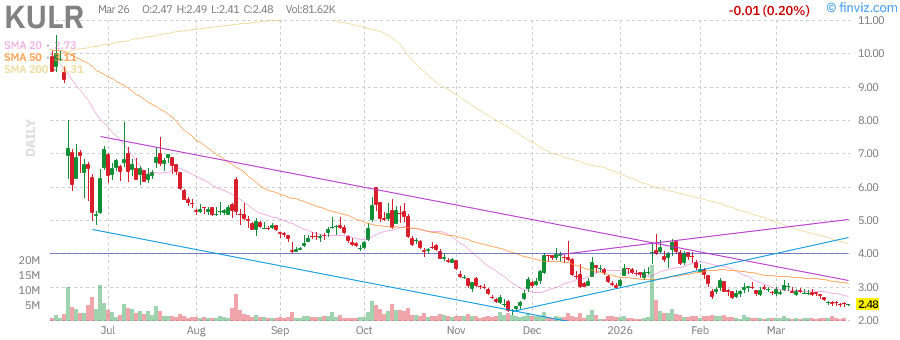
KULR Technology Group (NYSE American: KULR) is reporting Q4 2025 earnings this morning, and the stock has a lot riding on the numbers. But the bigger story isn’t the quarter itself — it’s what KULR announced alongside it: a co-development agreement with Robinson Helicopter Company to build the battery system for Robinson’s eR66 electric helicopter demonstrator. For a $128M micro-cap that’s been burning cash while building its technology stack, landing the world’s largest civil helicopter manufacturer as a partner is the kind of milestone that either validates the thesis or teases retail investors one more time.
Here’s where KULR actually stands heading into today’s report — and what investors need to watch.
The Numbers: What to Expect from Q4 2025
Analysts are projecting Q4 revenue of $4.40 million and EPS of ($0.08). That would bring full-year 2025 revenue to roughly $17.7 million — a 65% jump from FY2024’s $10.7 million — if the quarter lands near consensus. KULR has already reported Q1 through Q3 2025: $2.45M, $3.97M, and $6.88M respectively. That hockey-stick shape in Q3 — more than doubling Q2 — is what’s gotten people interested.
The revenue acceleration is real. What’s also real: the cost structure hasn’t caught up. Q3 operating expenses hit $9.37M on $6.88M in revenue. Gross profit in Q3 was just $630K. KULR is spending heavily on SG&A ($6.26M in Q3 alone) and R&D ($2.32M) while scaling manufacturing for contracts like the $30 million Caban Energy preferred battery supply agreement signed in January 2026.
The question for Q4 isn’t just whether revenue beats $4.40M. It’s whether gross margins improved. In Q4 2024, KULR posted $3.37M in revenue with $2.14M gross profit — a 63% gross margin. Q3 2025 gross margin collapsed to 9% as COGS spiked with the Caban manufacturing ramp. A recovery toward 30-40% gross margin in Q4 would signal the production scale-up is working. A repeat of Q3’s thin margins is a problem.
The Bitcoin Treasury: 610 BTC and What It Actually Cost
In December 2024, KULR announced it would allocate up to 90% of its surplus cash to Bitcoin. As of February 2026, the company held 610 BTC — purchased at weighted average prices in the $95K-$104K range per coin. Total Bitcoin acquisitions reached approximately $60 million.
KULR tracks “BTC Yield” as a KPI — the percentage change in Bitcoin holdings relative to fully diluted shares outstanding. Through February 2026, it reported 167.3% BTC Yield YTD. This is a MicroStrategy-style framework: frame Bitcoin accumulation as shareholder value creation, not speculation.
The problem: at current BTC prices around $85K, KULR’s Bitcoin treasury is likely underwater on paper versus its cost basis. The $15M gap between enterprise value ($98M) and market cap ($128M) suggests the market is already applying a Bitcoin discount. The stock trades at a price-to-book ratio of 0.77 — below book value. That’s either an opportunity or a warning that book value isn’t trustworthy.
The Robinson Helicopter Deal: What It Means (And What It Doesn’t)
Announced this morning: KULR signed a co-development agreement with Robinson Helicopter Company (RHC) to build the battery system for the eR66 battery-electric helicopter demonstrator. Robinson has manufactured more civil helicopters than any other company on Earth. The eR66 targets organ transport and short-haul zero-emission commercial flight, with program milestones targeted for late 2026.
KULR CEO Michael Mo said: “Robinson Helicopter has built more civil helicopters than any manufacturer on Earth, and their commitment to reliability is exactly the standard KULR’s battery architecture is designed to meet. KULR’s battery systems have been qualified for NASA spaceflight. The eR66 is where that architecture proves itself in rotorcraft.”
This fits the pattern KULR has been building: NASA-qualified battery tech → military/defense contracts → telecom backup power (Caban) → drone batteries (Hylio) → AI data center BBUs → now civil aviation. Each contract is incremental validation that the KULR ONE battery architecture works across markets. Each is also relatively small at the current stage.
The Robinson deal is a co-development agreement, not a purchase order. Revenue from it won’t show up until late 2026 at the earliest. Bulls call this validation; bears call it another press release before profitability arrives.
The Bull Case
Revenue grew 116% year-over-year in Q3 2025. The Caban deal introduces recurring revenue — 50,000 battery packs per month target by Q3 2026. Analyst consensus sits at $8.00 per share with one target at $12.00; the stock is at $2.50. The 52-week high is $14.80. KULR trades at 0.77x book. The KULR ONE BBU platform for AI data center rack-level backup power puts it directly in the path of hyperscale infrastructure spending. And the Russell 2000 is outperforming the S&P 500 by roughly 6.5 percentage points YTD — small caps are having a moment.
If Q4 revenue beats and gross margins recover toward 30%+, the narrative shifts from “burning cash with good PR” to “scaling toward profitability.” That’s the stock that triples.
The Bear Case
KULR has been burning cash for years. Net loss was $17.5M in FY2024. Q3 2025 SG&A alone ($6.26M) nearly matched total revenue ($6.88M). Shares outstanding jumped from 23M in FY2024 to approximately 45M today — the ATM equity program has been a persistent dilution machine, used to fund both operations and Bitcoin purchases.
The Bitcoin bet was made near the top. If BTC falls to $60K, that’s a potential $15M+ paper loss sitting on the balance sheet alongside an already wide operating loss. The manufacturing ramp to 50,000 packs per month is ambitious; delays would stall the Caban economics. And the retail-heavy investor base combined with a 2.01 beta means any earnings miss hits fast and hard.
Robinson Helicopter, Caban, Hylio, the Navy contract — these are all legitimate. None yet generates enough revenue to offset the cost structure. The company needs one or two of these to accelerate materially in 2026.
Key Metrics to Watch This Morning
- Revenue vs. $4.40M consensus: A beat above $5M changes the FY2025 story significantly
- Gross margin: Q3’s 9% was alarming. Anything above 25% shows the manufacturing ramp is normalizing
- Bitcoin holdings: Current BTC count and marked-to-market value vs. cost basis
- Cash and runway: How many quarters at current burn rate? This is the survival question
- FY2026 guidance: Any revenue guidance will be the most watched number after Q4 actuals
Verdict: Compelling Setup, Requires Q4 Delivery
KULR is doing real work in battery safety and thermal management — technology that matters across AI infrastructure, defense, space, and electric aviation. The Robinson Helicopter deal is the most credible third-party validation yet that the KULR ONE architecture competes at a serious level.
But at $2.50 with 45M+ diluted shares and ongoing losses, this is a company where the technology is proven and the business model is still being stress-tested. The stock looks cheap versus analyst targets, and cheap versus book value. It doesn’t look cheap if gross margins don’t recover and cash burn continues at Q3’s pace.
Watch the gross margin line this morning. If it’s back above 30%, the Robinson deal + Caban ramp + AI data center BBU pipeline adds up to a real re-rating story. If margins are still in single digits, the press releases are running ahead of the financials.
For more context on small cap defense and energy tech plays, see our analysis of small cap defense stocks investors are overlooking while everyone buys Rheinmetall, our deep dive on UAMY’s $248M defense contract and antimony monopoly, and our look at Planet Labs’ defense space analysis.
This is not financial advice. Do your own research. I hold no position in KULR.